
The Line as a Moral Symbol
The Narrow Road to the Deep NorthThis flow traces how the railway becomes both a literal route of forced labour and a symbol of linear progress, imperial violence, and impermanence.
increasing Bearing strength in each event
 decreasing
Bearing strength in each eventdecreasingA Breadthless Line
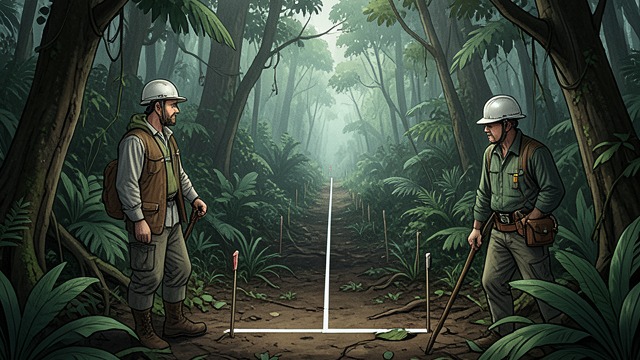
A Line Through the Jungle
A Geometric Idea
Dorrigo Evans thinks of a line as a breadthless length, a route proceeding from one point to another. The survey pegs make the abstract idea visible.
A Passage to Hell
For the prisoners, the line will connect work to death as much as it connects territories. Its apparent simplicity conceals an experience that words cannot contain.
Progress Without Freedom
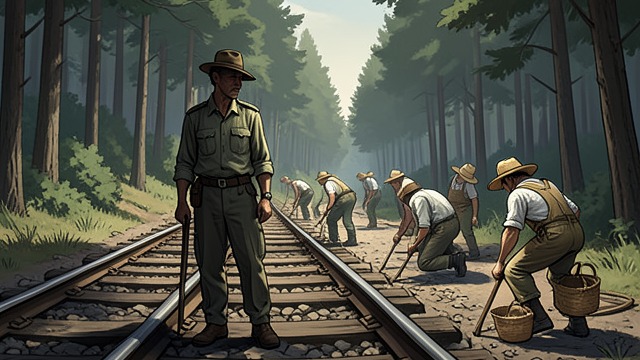
Two Ideas of Progress
The Imperial Claim
Major Nakamura argues that progress does not require freedom. The railway, in his account, gives suffering a place in national destiny.
The Human Cost
Dorrigo sees that the language of progress makes coercion sound inevitable. The conflict is not only over labour but over whether people can be treated as material for a future they did not choose.
A Railway of Corpses
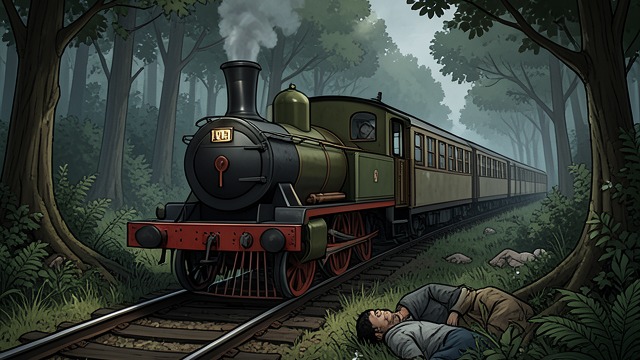
Completion and Concealment
The First Train
Locomotive C 5631 travels the route in a ceremonial journey. The construction project appears to have fulfilled the command’s ambition.
The Uncounted Dead
The line’s commemorations omit the people whose labour made it possible. The railway becomes a physical monument that also conceals its own foundations.
The Line Breaks Down
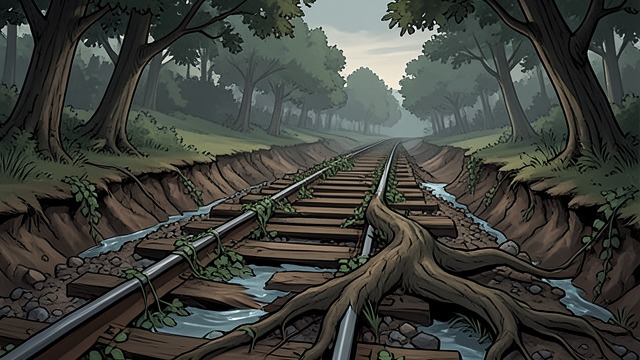
Impermanence in the Landscape
Rails Disappear
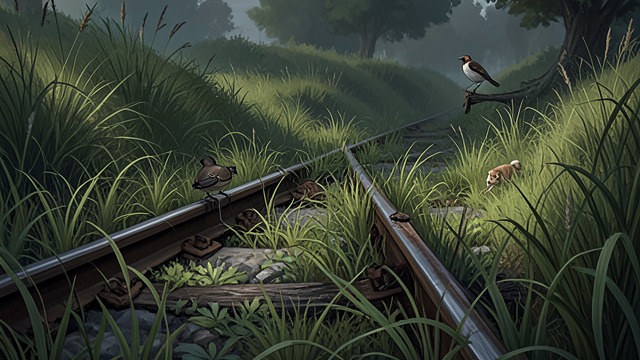
The track is dismantled or abandoned; its banks collapse and its cuttings fill. Human plans are gradually overtaken by weather and vegetation.
The Living World Continues
The jungle does not remember the railway as an imperial achievement. Its return challenges the belief that human projects possess permanence or meaning simply because they are large.
A Fragment of Grass
What Remains
Ruin and Renewal
The railway’s traces lie beneath long grass, while plants and animals continue without regard for human memorials. The project’s vast ambition has not secured its meaning.
An Unfinished Judgment
The dead may be forgotten, but their suffering remains part of the story’s moral ground. The landscape offers neither absolution nor a final explanation.
At the first railway survey, before the prisoners clear the route
During Nakamura and Dorrigo’s discussions of the project
At the railway’s completion in October 1943
After the Japanese Empire’s defeat
In the novel’s closing movement, after decades of decay
